
What Is a Scintillator?
A scintillator is a material that converts energy deposited by ionizing radiation into light. A photosensor detects that light, and electronics turn the sensor output into a measurement. Scintillators can be crystals, plastics, liquids or other suitable materials; they are not all the same type of radiation detector.
This guide explains scintillator meaning, the detection process and the difference between crystal and plastic materials. For engineering selection, continue to our scintillation crystal selection guide or plastic scintillator selection guide.
How Does a Scintillator Work?
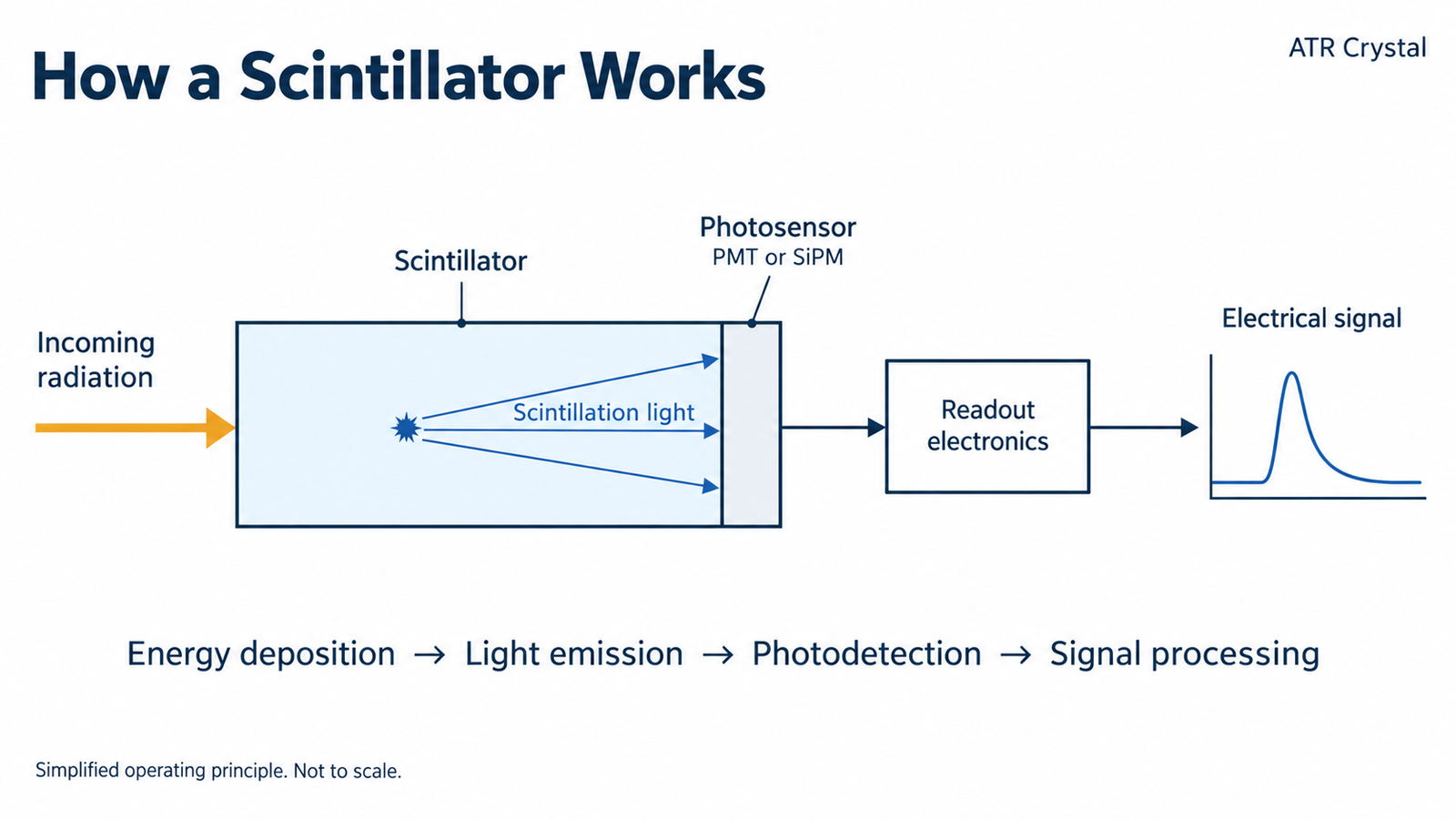
- Radiation deposits energy. An interacting particle or photon transfers energy to the material. The deposited energy may be less than the incident energy if some radiation escapes.
- The material emits light. Excited states release part of that energy as optical photons. The mechanism and emission spectrum depend on the material.
- Light reaches a sensor. Optical surfaces, reflectors and coupling help transport light to a photomultiplier tube, silicon photomultiplier or another suitable photosensor.
- Electronics process the signal. Depending on the system, the signal can indicate an event, its arrival time, deposited energy or interaction position.
Energy deposition → scintillation light → photosensor signal → electronic measurement.
NASA describes this energy-to-light conversion for X-ray scintillation detectors. The IAEA detector training module explains the optical coupling and photomultiplier signal chain.
Scintillator vs. Scintillation Detector
The scintillator is the light-producing material. A scintillation detector combines that material with light collection, a photosensor and the electronics needed for its intended measurement. Buying a crystal or plastic panel does not by itself provide a complete working instrument.
This distinction matters when requesting a quotation: specify whether you need a material sample, a polished component, an array or an assembled detector. ATR’s linked product routes below concern scintillator materials and components.
Crystal, Plastic and Liquid Scintillators
Inorganic crystal scintillators
Examples include NaI(Tl), BGO and GAGG(Ce). In activated crystals, a dopant introduces luminescent centers; this should not be assumed to describe every scintillating material. Crystal selection depends on the radiation, geometry, optical response and packaging requirement.
Plastic scintillators
Plastic scintillators use a polymer matrix with fluorescent compounds. For example, Eljen describes PVT-based materials containing fluors, supplied in geometries such as sheets, blocks and rods. Organic molecular excitation and energy transfer are central to their operation; a description of thallium-activated NaI should not simply be reused as the explanation for plastic.
For panels, strips or thin detection layers, review our plastic scintillator materials. Specify dimensions, readout location and optical finish together.
Liquid scintillators
Liquid scintillation systems use a liquid formulation and a compatible measurement arrangement. They are a separate material family, not a liquid form of an inorganic crystal. The IAEA reference above introduces this distinction. The inclusion here explains terminology and does not indicate ATR liquid-scintillator availability.
Why Material Choice Changes the Measurement
Light yield, decay behavior and sensor response must be considered together. A high photon yield does not guarantee the largest electrical signal with every sensor, and a short decay time alone does not specify the timing resolution of a finished detector.
CAEN’s comparison experiment uses BGO, LYSO(Ce) and CsI(Tl) crystals with matching dimensions and a defined readout setup. It illustrates why comparisons should identify geometry, optical treatment and electronics instead of treating unrelated data-sheet values as equivalent measurements.
Before choosing a material, write down the radiation and energy range, required active area, crystal or panel thickness, sensor model, operating environment and the measurement you need to make.
If your measurement depends on separating gamma-ray energies, see our scintillator energy resolution guide for the FWHM calculation and the test conditions to include when comparing specifications.
Is a Scintillator the Same as a Geiger Counter?
No. A scintillation detector reads light from a material. A Geiger–Müller counter detects a discharge in a gas-filled tube. Both can register radiation events, but their operating principles and measurement capabilities differ. See OpenStax’s introduction to radiation detectors.
For a side-by-side comparison of operating principles and measurement capabilities, read our scintillator vs Geiger counter guide.
From Understanding the Principle to Selecting a Component
- Comparing inorganic crystals? Start with the crystal material selection guide, then review the relevant product specification.
- Planning a plastic panel or thin layer? Use the plastic scintillator guide to organize the application and geometry requirements.
- Ready for a material quotation? Send the material or application, dimensions, quantity, readout method and drawing to sales@atrscintillator.com. State any numerical acceptance criteria and how they should be measured.
Final material grade, processing and acceptance criteria are confirmed for the requested component.