
GAGG and BGO scintillator crystals suit different measurement priorities. A GAGG crystal usually offers higher scintillation light output, while BGO provides higher density. Compare the required active volume, light collection and readout before choosing a material for gamma-ray detection. This guide helps you decide which crystal specification to send for quotation.
For GAGG, confirm the proposed grade: light yield and decay values from different grades should not be combined into one specification. For both materials, compare energy resolution and count-rate performance under defined readout conditions rather than inferring a finished detector result from density or light output alone.
GAGG vs BGO: the numbers worth comparing
The values below are reference material properties, not guaranteed specifications for every supplied crystal. In particular, GAGG grades should not be treated as interchangeable.
| Property | GAGG(Ce) | BGO |
|---|---|---|
| Density | Approximately 6.6 g/cm³ | Approximately 7.13 g/cm³ |
| Emission peak | Approximately 520 nm | Approximately 480 nm |
| Reference light yield | 45,000–55,000 photons/MeV for the conventional grade cited below; other grades differ | Approximately 9,000 photons/MeV in the cited reference |
| Reference scintillation decay | Approximately 90 ns for that conventional grade; confirm the actual grade | Approximately 300 ns |
| First design question | How much of the additional light reaches the sensor? | Does the absorption advantage justify the lower light signal? |
Material references: C&A GAGG material data, C&A grade comparison, and the scintillator-property table in Luxium’s scintillation technical note. These sources describe reference materials, not the manufacturer or guaranteed performance of an ATR quotation.
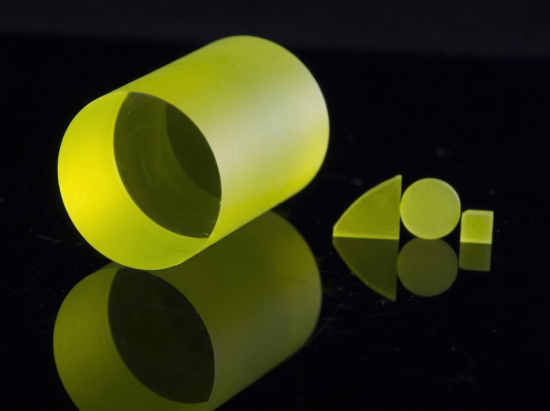
More light is useful only if you collect it
For a spectroscopy project, GAGG is worth evaluating when the detected light signal is a limitation. But a light-yield figure alone cannot promise a particular energy resolution. The finished crystal, optical coupling and readout all need to be assessed together.
For SiPM readout, check the sensor’s photon detection efficiency across the emission spectrum, rather than choosing it by its peak sensitivity alone. GAGG and BGO emit at different wavelengths, and SiPM detection efficiency also depends on operating conditions. Hamamatsu’s MPPC technical explanation describes these dependencies.
A useful quotation check is the unit used for light output. Photons/MeV describes emitted scintillation light; photoelectrons/keV describes a detected signal under specified measurement conditions. They are not interchangeable. Converting MeV to keV changes the energy unit, but does not account for optical losses or detector efficiency.
If a supplier quotes an energy-resolution result, ask for the gamma-ray energy, sample dimensions, photosensor and integration settings. A result from a small test cube is not automatically the acceptance value for a long pixel or a finished array.
For stopping power, compare the actual geometry
BGO’s density makes it an attractive candidate when detector volume is restricted. However, the density ratio between BGO and GAGG is not a detector-efficiency ratio. Gamma-ray energy and material composition matter too.
There are two different comparisons you can request:
- Same dimensions: compare both materials inside the available mechanical envelope.
- Same detection target: determine the dimensions each material needs for the required response, then compare size, weight and cost.
Also define what “efficiency” means. A gamma ray interacting in the crystal is not necessarily recorded in the full-energy peak. For a demanding design, request an energy-specific calculation or measurement for the proposed geometry, rather than choosing from density alone.
Do not select a GAGG grade by its fastest number
A GAGG listing may describe a high-light-output grade, a faster grade or a grade selected for another performance characteristic. The highest light yield and shortest decay time may belong to different products. C&A’s published grade comparison is one example of this trade-off.
Ask for the light yield and decay specification of the same quoted grade. For ATR’s available grade descriptions, see the GAGG(Ce) selection guide.
Decay time is also not a direct specification for maximum count rate or coincidence timing resolution. Integration time, event processing and the timing method must be considered. If timing is the deciding requirement, ask for a detector-level result at the intended operating conditions. A separate LYSO vs BGO comparison is useful when LYSO is also on the shortlist.
For an array, put the optical interfaces on the drawing
“A 4 × 4 array” does not define enough to compare two quotations. Record the pixel cross-section, crystal length, pixel pitch, inter-pixel reflector thickness and overall dimensions. Pixel size and pitch are different measurements.
Mark the sensor-coupling face and specify which other surfaces are polished, lapped or wrapped. Include the reflector and any optical window or light guide. Otherwise, a nominal GAGG-versus-BGO test may also be comparing two different light-collection arrangements.
Keep the assembly drawing consistent between suppliers. If one supplier recommends a different finish, ask them to quote it as a clearly identified alternative rather than silently changing the baseline.
A practical way to compare samples
Before ordering a larger batch, agree on a small set of acceptance measurements. The following is a suggested comparison plan, not a claim of test results from an ATR detector:
- Use the same source geometry and record the temperature and acquisition time.
- Record the sensor model, coupling arrangement, bias and electronics settings.
- Compare the result that matters to the project: for example, full-energy peak counts, energy resolution or pulse overlap.
- If each material needs different readout settings, optimise them separately and document the changes. Keep a common-setting comparison as a baseline where practical.
A replacement test and a new detector design need different decisions. For a replacement, compatibility with the existing readout matters. For a new design, allowing a different sensor or integration setting may change which crystal is preferable.
Compare complete quotations, not just price per crystal
There is no reliable rule that one of these materials is always cheaper for a custom part. Ask for matching dimensions, surface treatment, reflector, quantity and inspection requirements. For GAGG, include the grade. Identify any packaging or assembly work that is excluded.
Send ATR Crystal the drawing, gamma-ray energy range, photosensor model and required quantity, together with the main performance target. Our GAGG(Ce) product page and BGO product page provide starting specifications. The quotation should then state the offered configuration and any deviations explicitly.