
Short Answer
GAGG(Ce), also written as GAGG:Ce or Ce:GAGG, is a dense, non-hygroscopic garnet scintillator used for gamma-ray detection, X-ray imaging, compact detector modules and pixelated arrays. It is often selected when a project needs strong light output, green emission near 520 nm, practical handling and compatibility with SiPM or photodiode readout.
Choose a GAGG(Ce) scintillation crystal for a monolithic detector component, material test sample or custom part. Choose a GAGG(Ce) scintillator array when the system needs spatial resolution, defined pixel pitch or multi-channel readout. Do not select GAGG(Ce) by light output alone: decay behavior, afterglow, surface finish, reflector, photosensor and crystal geometry all affect the final detector.
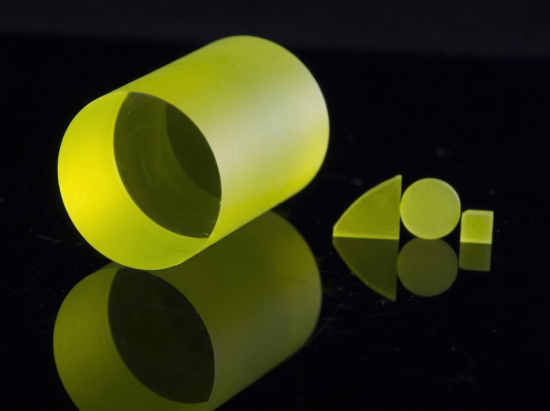
What Is GAGG Crystal?
GAGG(Ce) is cerium-doped gadolinium aluminum gallium garnet. A commonly used nominal composition is Gd3Al2Ga3O12:Ce, although the aluminum-to-gallium ratio, cerium concentration and co-doping route can vary by grade. Those differences can change light output, decay components, afterglow and radiation-response behavior.
The material combines density around 6.6 g/cm3, green emission near 520 nm and non-hygroscopic handling. Published detector work has paired GAGG(Ce) with SiPMs, silicon drift detectors and photodiodes. Its practical value is the balance between stopping power, photon output, mechanical handling and solid-state sensor compatibility.
GAGG(Ce) is lutetium-free, so it has no Lu-176 intrinsic background associated with LYSO(Ce) and LSO. Do not call it a “zero-background” material: total detector background also depends on the sensor, electronics, shielding, surrounding materials and radiation environment.
Typical GAGG(Ce) Properties
| Property | Typical Engineering Reference | Selection Note |
|---|---|---|
| Material | Cerium-doped gadolinium aluminum gallium garnet | Composition and co-doping vary by grade. |
| Density | About 6.6 g/cm3 | Supports compact gamma and X-ray detector geometry. |
| Emission peak | Typically near 520 nm | Check the photosensor photon-detection-efficiency curve at this wavelength. |
| Light output | Commonly reported in the tens of thousands of photons/MeV | Compare values only when crystal size, sensor and test method are comparable. |
| Decay behavior | Grade- and method-dependent; may contain multiple components | Confirm the definition when timing or count rate is important. |
| Afterglow | Depends on composition, co-doping, irradiation and measurement time | Do not assume every GAGG grade is low-afterglow. |
| Hygroscopicity | Non-hygroscopic | Reduces sealing complexity compared with NaI(Tl) or LaBr3(Ce). |
| Intrinsic activity | No Lu-176 intrinsic background | Total detector background must still be reviewed at system level. |
These are engineering references for early material selection, not final acceptance values. A purchase specification should identify the crystal grade, part size, sensor, test method, shaping time, temperature and acceptance limits.
When to Choose GAGG(Ce)
Compact gamma-ray detectors. GAGG(Ce) is useful when a detector needs relatively high density, strong photon output and practical handling in a compact volume. Typical projects include portable radiation instruments, gamma counters, detector prototypes and research modules.
SiPM- or photodiode-coupled modules. Green emission near 520 nm can match many silicon photosensors, but “SiPM compatible” is not a complete specification. Review the sensor model, active area, photon-detection efficiency, temperature range, optical coupling and electronic gain together.
Gamma and X-ray imaging. GAGG(Ce) can be supplied as a monolithic plate, thin screen or pixelated array. Imaging performance depends on thickness, pixel size, reflector, optical isolation and readout geometry, not only on bulk crystal properties.
Projects avoiding Lu-176 background. The lutetium-free composition can be useful for selected low-count-rate or background-sensitive designs, subject to a complete detector-background review.
When GAGG(Ce) May Not Be the Best Choice
Ultra-fast timing as the primary requirement. GAGG(Ce) grades can have useful timing performance, but LYSO(Ce), BaF2 or another timing-focused material may be a better starting point when coincidence timing dominates the design.
High-rate or radiation-exposed systems without an afterglow review. Residual luminescence can matter after irradiation. For space, high-dose imaging or low-threshold counting, define an afterglow test exposure and measurement interval before choosing the grade.
High-resolution gamma spectroscopy as the only priority. LaBr3(Ce), CeBr3, NaI(Tl) or semiconductor detectors may be more appropriate depending on the energy-resolution target, energy range, count rate, packaging and budget.
GAGG Crystal vs GAGG(Ce) Array
| Design Item | Monolithic GAGG Crystal | GAGG(Ce) Array |
|---|---|---|
| Best fit | Material evaluation, compact detector or single-channel readout | Imaging, position-sensitive detection or multi-channel readout |
| Primary dimensions | Length, width, thickness or diameter | Pixel size, pitch, pixel count and active area |
| Optical specification | Polished faces, coupling face, wrapping or coating | Reflector, reflector thickness, dead gap and optical isolation |
| Readout information | PMT, SiPM or photodiode model | Sensor-array layout, channel pitch and alignment tolerance |
| Common risk | Sensor mismatch or unsuitable surface finish | Crosstalk, non-uniformity or alignment error |
Review the GAGG(Ce) crystal page and provide finished dimensions, polished faces, sensor and quantity.
Review the GAGG(Ce) array page and provide pixel size, pitch, layout, reflector and sensor drawing.
GAGG(Ce) for SiPM Readout
Start with the emission spectrum and the SiPM photon-detection-efficiency curve, then confirm that the crystal coupling face and sensor active area are geometrically matched. A large crystal on a small sensor may lose light or require a light guide. Pixelated arrays also need pitch and channel-alignment control.
Reflector and coupling material affect light collection and crosstalk. ESR film, PTFE-based reflectors, diffuse coatings, optical grease and adhesives are not interchangeable; specify the operating temperature, sensor and intended optical path.
Comparing green-emitting scintillators for a silicon photosensor? Read our GAGG vs CsI(Tl) scintillator comparison for differences in scintillation response, SiPM and photodiode matching, moisture protection and detector packaging.
GAGG Crystal Price: What Changes the Quotation?
There is no reliable universal GAGG crystal price per piece. A quotation depends on usable crystal volume and how difficult the finished geometry is to manufacture, inspect and assemble.
| Price Factor | Why It Matters | Information to Send |
|---|---|---|
| Crystal grade | Light-output, decay and afterglow priorities can require different selection or testing. | Application and the property that matters most. |
| Finished size | Large volume, thin sections and unusual aspect ratios affect yield. | Dimensions, tolerance, chamfer and drawing. |
| Surface finish | Polishing, roughening, flatness and coating change machining scope. | Identify polished, roughened, coated and coupling faces. |
| Array geometry | Small pixels, thin reflectors and tight pitch increase complexity. | Pixel size, pitch, layout, reflector and active area. |
| Inspection | Dimensional, light-output and uniformity tests add scope. | Test method, sample size and acceptance limit. |
| Quantity and schedule | Prototype and production pricing use different setup assumptions. | Prototype quantity, annual demand and delivery date. |
Send the drawing and application together. “GAGG crystal price” alone does not distinguish a small polished sample from a detector array with controlled pitch and reflector thickness.
Information Needed for a GAGG(Ce) Quotation
A qualified request should include the detector application, radiation type or energy range, finished size, tolerance, surface finish, coupling face, reflector or coating, photosensor, quantity and requested delivery date. Include a drawing whenever the geometry is more complex than a simple block or cylinder.
For arrays, also specify pixel size, final pitch, number of pixels, reflector material, reflector thickness, active area, array thickness, entrance face, readout face and sensor-channel layout. If crosstalk or uniformity has a numerical requirement, provide the test method as well as the limit.
Application, size, tolerance, polished faces, coupling face, reflector or coating, sensor, quantity and inspection.
Pixel size, pitch, layout, thickness, reflector, readout face, sensor drawing, crosstalk target and quantity.
For a monolithic crystal, request a GAGG(Ce) crystal quotation. For a pixelated array, send your GAGG(Ce) array layout for quotation. Include the drawing, application and quantity so ATR Crystal can review the required material and processing.
FAQ
What is GAGG crystal?
GAGG crystal is the common name for cerium-doped gadolinium aluminum gallium garnet, a dense, non-hygroscopic scintillator used in gamma-ray and X-ray detector systems.
Is GAGG(Ce) suitable for SiPM readout?
Yes. Its emission is commonly near 520 nm, which can match many silicon photosensors. The exact SiPM model, active area, photon-detection efficiency, temperature range and coupling geometry still need to be checked.
Does GAGG(Ce) have intrinsic radioactivity?
GAGG(Ce) contains no lutetium and therefore has no Lu-176 intrinsic background. It should not be described as a zero-background detector material because environmental radiation, sensor noise, activation and other system components can still contribute background.
Is every GAGG(Ce) crystal low-afterglow?
No. Afterglow depends on composition, co-doping, irradiation history, temperature and the time interval used for measurement. Request a defined afterglow test when residual signal is important.
How much does GAGG crystal cost?
Price depends on grade, volume, geometry, tolerance, surface finish, array complexity, inspection, quantity and delivery schedule. A drawing and application description are required for a meaningful quotation.
Can I buy a single GAGG crystal instead of an array?
Yes. A monolithic crystal is appropriate for material evaluation, single-channel gamma detection and optical-coupling tests. Choose an array when the detector needs spatial resolution, controlled pixel pitch or multi-channel readout.