
Short Answer
BaF2, also called barium fluoride crystal, is a specialist inorganic scintillator selected when the detector needs very fast UV scintillation response, high-rate timing capability or a material that can also serve as a UV/IR optical component. Its key advantage is a fast scintillation component near 220 nm with a decay constant around 0.6 ns.
BaF2 is not automatically the best answer for every gamma detector. It also has a much slower component near 300-310 nm with a decay time around 600 ns. A timing-oriented detector must therefore use an appropriate UV-sensitive photosensor, optical path and slow-component-management approach. Review the BaF2 scintillation crystal product page when the project already has a drawing or detector requirement.
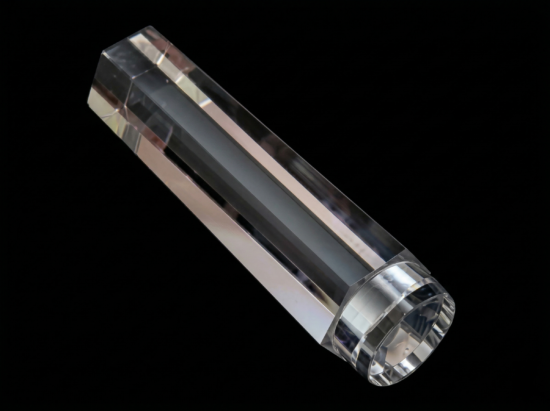
What Is BaF2 Scintillation Crystal?
BaF2 is barium fluoride, an inorganic crystal used both as a scintillator and as an optical material. In radiation detection, it is known for an ultrafast cross-luminescence component in the deep-UV region. In optical systems, it can also be reviewed for selected UV and IR windows, spectroscopy components and optical assemblies.
The engineering question is not simply whether BaF2 is fast. The useful question is whether the complete detector can collect the fast UV light while preventing the slower component from degrading pulse shape, pile-up behavior or timing performance.
BaF2 Fast and Slow Components
| Component | Typical Wavelength | Typical Decay Time | Design Meaning |
|---|---|---|---|
| Fast component | Near 220 nm | About 0.6 ns | Main reason BaF2 is considered for fast timing and high-rate detector research. |
| Slow component | Near 300-310 nm | About 600 ns | Can increase pile-up and degrade timing-oriented detector performance if not managed. |
The 0.6 ns value describes a material scintillation component. It is not the time resolution of a finished detector. Final timing performance also depends on crystal geometry, light collection, photosensor transit-time spread, photon-detection efficiency, electronics bandwidth, threshold, calibration and event statistics.
Why Deep-UV Readout Matters
A standard visible-light detector chain may not efficiently collect BaF2‘s fast 220 nm emission. For a timing detector, verify the sensor response, optical window, coupling material, reflector and adhesive at the relevant UV wavelength before choosing the crystal.
A successful BaF2 timing design normally starts with these questions:
Confirm the photosensor sensitivity, window transmission and optical-coupling compatibility in the deep-UV region.
Define whether the project uses selective readout, filtering, material grade selection, waveform processing or another validated method.
When to Choose BaF2 Crystal
Fast timing research. BaF2 is a strong candidate when the project prioritizes a fast scintillation component and can support deep-UV readout.
High-energy and nuclear physics detectors. Its fast response has made BaF2 relevant to timing-sensitive calorimetry, particle-detection studies and high-rate experimental systems.
Time-of-flight and coincidence studies. It can be reviewed where fast photon generation is important, provided the slow component and detector electronics are addressed at system level.
UV and IR optical components. BaF2 may also be considered for optical windows or spectroscopy components when the required transmission range, surface quality, environmental conditions and mechanical handling are clearly specified.
When BaF2 May Not Be the Best Choice
General gamma spectroscopy. If the main goal is practical energy resolution rather than UV timing, NaI(Tl), LaBr3(Ce), CeBr3 or another material may be more suitable depending on the detector requirement.
Visible-only sensor chains. If the photosensor, window and optical coupling cannot efficiently collect deep-UV light, the main timing advantage of BaF2 may not be realised.
High-rate systems without slow-component control. The slow emission can contribute to pile-up. Do not claim high-rate performance without defining how the slow component is suppressed, rejected or handled in the readout chain.
Rough handling or unprotected polished surfaces. BaF2 is relatively soft and somewhat moisture-sensitive. Packaging, cleaning, storage and optical-surface protection should be part of the quotation discussion.
BaF2 vs LYSO, BGO, GAGG and NaI(Tl)
| Material | Main Strength | Key Limitation | Typical Starting Point |
|---|---|---|---|
| BaF2 | Fast deep-UV component around 220 nm | Slow component and specialized UV readout requirements | Fast timing, high-rate research and UV/IR optics |
| LYSO(Ce) | High density and practical fast timing | Lu-176 intrinsic background | PET, TOF-PET and compact gamma detector modules |
| GAGG(Ce) | High light output, green emission and non-hygroscopic handling | Decay and afterglow depend on grade | Compact gamma detectors, imaging and SiPM modules |
| BGO | High density and strong gamma stopping power | Lower light output and slower timing | Absorbers, shields and calorimetry |
| NaI(Tl) | High light output and mature gamma-spectroscopy use | Strong hygroscopicity and hermetic packaging | Survey meters and standard gamma spectroscopy |
For a broader materials overview, read the scintillation crystal types selection guide. For a BaF2 project, the selection decision should begin with readout wavelength and timing architecture, not only with density or material price.
BaF2 Crystal Price and RFQ Factors
There is no reliable universal BaF2 crystal price per piece. The quotation depends on crystal grade, finished dimensions, surface quality, wavelength requirement, optical or detector use, inspection method, quantity and delivery schedule.
| RFQ Item | Information to Provide |
|---|---|
| Application | Fast timing detector, high-energy physics, nuclear measurement, UV window, IR window or spectroscopy component. |
| Crystal type | Scintillation-grade BaF2, optical-grade BaF2 or supplier recommendation. |
| Dimensions | Length, width, thickness, diameter, tolerance, chamfer and drawing. |
| Surface requirement | Polishing, flatness, surface quality, clear aperture and protected faces. |
| Readout or wavelength | Photosensor type, fast-component target, optical window, filter or transmission wavelength range. |
| Assembly | Bare crystal, reflector, wrapping, coating, optical coupling or housing. |
| Inspection | Dimensional check, visual inspection, transmission, light output, surface report or other acceptance item. |
| Commercial details | Quantity, prototype or production stage, delivery schedule and export packing requirement. |
The project needs deep-UV fast scintillation response and the readout chain can collect the 220 nm component.
The main priority is conventional gamma spectroscopy, visible-light readout simplicity or energy resolution without a timing requirement.
Send the drawing and readout requirement through the technical inquiry form. ATR Crystal can review whether BaF2 should be supplied as a scintillation crystal, optical component, wrapped detector element or custom assembly.
FAQ
Is BaF2 the same as barium fluoride crystal?
Yes. BaF2 is the chemical formula for barium fluoride. It may be supplied as a scintillation crystal, UV/IR optical component or custom detector material.
Why is BaF2 used for fast timing?
BaF2 has a fast deep-UV scintillation component near 220 nm with a decay constant around 0.6 ns. The final detector still requires suitable UV-sensitive readout and electronics.
Does the 0.6 ns BaF2 decay time mean my detector has 0.6 ns time resolution?
No. It is a material decay constant, not a finished detector time resolution. Crystal size, light collection, sensor performance, electronics, threshold and calibration determine system-level timing performance.
What is the BaF2 slow component?
BaF2 also has a slower scintillation component near 300-310 nm with a decay time around 600 ns. It can cause pile-up or reduce timing performance if the detector is not designed to manage it.
Is BaF2 suitable for SiPM readout?
It can be, but the SiPM and complete optical chain must have appropriate deep-UV response. Do not assume a standard visible-light SiPM arrangement will collect the fast component efficiently.
Is BaF2 hygroscopic?
BaF2 is somewhat moisture-sensitive. Polished surfaces should be protected during storage, handling and assembly.