
Plastic Scintillator Selection Guide for Muon, Gamma and Beta Detection
Plastic scintillator is often selected when a detector needs a large active area, fast response, low material cost and practical machining. In customer discussions it may also be called scintillating plastic or scintillation plastic. These names usually point to the same material class: an organic plastic base that emits light when ionizing radiation deposits energy inside it.
The choice is not only about the material name. A plastic scintillator panel for atmospheric muon measurement, a thin sheet for beta counting, and a small pixelated array for SiPM readout can all use plastic scintillator, but the design details are very different. Thickness, reflector, coupling method, sensor type and acceptance test should be defined before the material is quoted.
Short Answer
For a general radiation detection project, start with a fast blue-emitting plastic scintillator such as an SP101-class material. For large-area muon counters, define the panel size, thickness, optical coupling and readout sensor first. For beta detection, consider a thinner plastic scintillator sheet such as an SP102-class material. For alpha or alpha/beta monitoring, a ZnS(Ag)-coated scintillator screen may be more appropriate than ordinary fast plastic.
If a buyer asks for EJ-200, EJ-204 or BC-408, confirm whether original imported material is required or whether an equivalent performance-class material is acceptable. “Equivalent” should not be treated as identical to the original brand unless the supplier explicitly confirms the exact material source.
Choose a Plastic Scintillator for Your Project
- Projects considering an EJ-200 alternative: Review ATR-P200 fast plastic scintillator for particle counters and cosmic-ray detector components. Compare its listed material properties with your detector requirements before selecting a replacement.
- General-purpose plates, bars and blocks: View SP101 plastic scintillator for material specifications and custom geometries.
- Thin sheets for beta detection: View SP102 thin plastic scintillator sheets and specify the required thickness, active area and application.
- Light guides for optical coupling: View SPM100 PMMA light guides for the interface between your scintillator and photosensor.
For a quotation, send your project requirements. Include the material requirement, finished dimensions, quantity and intended application. If replacing an existing scintillator, include its datasheet and the properties your detector must retain.
When Plastic Scintillator Is the Right Choice
Plastic scintillator is useful when detector size, mechanical shape and fast timing matter more than maximum gamma stopping power. Its low density makes it easier to produce large plates and long bars, while the fast decay time supports timing and coincidence measurements.
| Application | Why Plastic Scintillator Is Used | Main Design Point |
|---|---|---|
| Atmospheric muon or cosmic-ray muon detection | Large panels are practical, lightweight and relatively economical. | Panel size, thickness, light collection and PMT or SiPM placement. |
| Gamma-ray Compton scatterer layer | Low-Z plastic is suitable as a scatterer material in some detector layouts. | Pixel pitch, reflector thickness, optical isolation and SiPM matching. |
| Beta-ray detection | Thin sheets can help detect beta particles while limiting unnecessary gamma interaction. | Thickness, entrance window, air gap and detector threshold. |
| Portal monitors and area radiation monitors | Large active area can be achieved at lower weight and cost than many crystal scintillators. | Panel uniformity, attenuation length, wrapping and sensor coupling. |
| Prototype detector assemblies | The material can be machined into panels, bars, blocks or custom shapes. | Drawing, tolerance, surface finish and final assembly method. |
SP101-Class Material for General Plastic Scintillator Panels
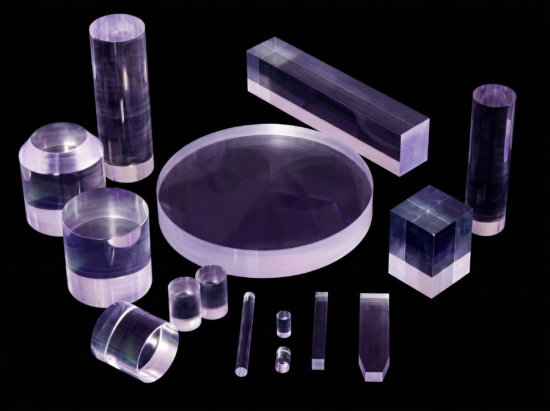
For general-purpose plastic scintillator plates, bars and panels, ATR Crystal usually starts from an SP101-class plastic scintillator. SP101 is a blue-emitting polystyrene-based plastic scintillator used for gamma rays, X-rays and general ionizing radiation detection. It can be machined into plates, slices, blocks, bars, cylinders, rings and custom detector parts.
The listed SP101 data includes 423 nm peak emission, 2.4 ns decay time, 0.9 ns rise time, 1.023 g/cm3 density, 1.58 refractive index and 210 cm attenuation length. These values make it practical for many PMT, SiPM and silicon photodiode readout designs. Final detector response still depends on geometry, reflector, optical coupling and electronics.
For custom detector assemblies, review the SP101 Plastic Scintillator product page together with your sensor layout and mechanical drawing.
EJ-200 Equivalent Does Not Always Mean Original EJ-200
Many researchers use EJ-200, EJ-204, BC-408 or similar names as a shorthand for fast plastic scintillator performance. That is normal in early discussions, but it should be clarified before quotation. Original EJ material, domestic equivalent material and another BC-408-class material may all be suitable for a prototype, but they are not the same commercial product.
A safe RFQ should say one of the following:
- Original EJ-200 or EJ-204 required: the supplier must confirm the original material source, cost and lead time.
- EJ-200 equivalent accepted: the supplier can propose a fast plastic scintillator with similar emission, decay time and application fit.
- Material recommendation requested: the supplier should recommend a material based on radiation type, sensor and geometry.
This one sentence prevents many quotation mistakes. It also helps avoid a low price that is based on domestic equivalent material when the customer expected original imported material.
How to Choose Thickness for Muon Detection Panels
For atmospheric muon measurement, the panel thickness is usually selected together with light collection design. A thicker plate can produce more scintillation light, but it also increases weight, material cost and mechanical load. A thinner panel may be cheaper and easier to handle, but the optical collection and signal threshold must be checked carefully.
For example, a customer may ask for a plastic scintillator panel around 640 x 320 mm for a muon telescope or educational cosmic-ray setup. In that case, the quotation should not only list material size. It should also define whether the panel is supplied as a bare polished plate, wrapped panel, aluminum-housed module, or a complete detector with PMTs, HV bases and signal connectors.
| Supply Level | What Is Included | Best For |
|---|---|---|
| Bare plastic scintillator plate | Cut and polished plastic scintillator panel. | Labs that already have optical wrapping, sensors and electronics. |
| Wrapped scintillator panel | Panel with reflective treatment and light-tight wrapping or protection. | Projects that need faster assembly but have their own readout system. |
| Detector module | Scintillator, reflector, housing, PMT or SiPM coupling and connectors. | Users who need a ready-to-test detector package. |
For more detail on panel geometry, wrapping and readout requirements, see our plastic scintillator panel guide for cosmic-ray muon detection.
Plastic Scintillator for SiPM Arrays
Small pixelated plastic scintillator arrays are different from large panels. In a SiPM-matched array, the most important point is often the final pitch, not the raw pixel size. If the final pitch must be 4.00 mm, the reflector and bonding layer must be included inside that pitch. A 4.00 mm plastic pixel plus reflector will make the final pitch larger than 4.00 mm, which may no longer match the SiPM array.
For this type of request, provide the SiPM model, active area, target pitch, total active matrix size, pixel thickness, reflector type and whether five external faces need reflector wrapping. If the readout face must remain open and polished for optical grease, gel or silicone pad coupling, write that directly in the drawing or RFQ.
Thin Plastic Scintillator for Beta Detection
For beta detection, a thick panel is not always the best choice. A thin plastic scintillator sheet can reduce unnecessary gamma interaction and keep the detector closer to the beta-sensitive layer. ATR Crystal’s SP102 Plastic Scintillator is positioned for beta-ray measurement, charged-particle detection, surface contamination monitoring and PM2.5 beta attenuation instruments.
When specifying a beta detector sheet, include the beta source or energy range, detector window, air gap, active area, thickness, surface finish and readout method. Low-energy beta particles can be strongly affected by window material and distance, so the mechanical design is part of the detector performance.
When a Light Guide Is Needed
A light guide is not the active scintillator. It is an optical component used to transfer scintillation light from the detector body to a PMT, SiPM or photodiode. A light guide may be useful when the sensor active area does not match the scintillator geometry, or when the sensor must be placed away from the active region.
For optical coupling layouts, see SPM100 Light Guide. The final shape should be reviewed together with refractive index, coupling material, polishing, reflector and sensor position.
Plastic Scintillator Machining and Polishing Requirements
Custom plastic scintillator machining starts with a drawing that defines the finished dimensions, tolerances and optical interfaces. For plates, bars, strips or tiles, identify which surfaces collect or transmit light and which surfaces will be wrapped, supported or enclosed.
Plastic scintillator polishing requirements should be specified by surface rather than described only as “fully polished.” Mark the photosensor or light-guide coupling faces on the drawing and state any inspection requirements. Machining feasibility and the available finish should be confirmed before quotation.
| Requirement | What to Include in Your Drawing |
|---|---|
| Finished geometry | Length, width, thickness or cross-section, with dimensional tolerances |
| Optical polishing | Faces requiring polishing, coupling-face dimensions and inspection criteria |
| Holes, grooves and edge features | Locations, dimensions and tolerances for machining feasibility review |
| Wrapping and assembly | Surfaces to be wrapped, exposed optical interfaces and housing constraints |
For drawing-defined components, review our SP101 plastic scintillator plates and bars. Email your drawing and quantity to sales@atrscintillator.com, and specify whether the request includes material supply, machining, polishing or additional finishing.
What Affects Plastic Scintillator Price?
Plastic scintillator price depends on the specified material, finished dimensions, quantity and processing requirements. To compare quotations, use the same drawing and supply scope rather than comparing material names alone.
| Quotation Item | What to Confirm |
|---|---|
| Material grade | Specify the required grade or performance criteria. If an original branded material is mandatory, state this explicitly. |
| Dimensions and quantity | Provide finished length, width, thickness or cross-section, tolerances and the number of pieces. |
| Machining and polishing | Identify optical faces, edge features, holes or grooves requiring feasibility review. |
| Finishing and assembly | Define whether the quotation covers bare material, reflector wrapping, light guides or additional assembly. |
| Inspection and delivery | Specify acceptance criteria, packaging requirements, delivery destination and any requested schedule. |
For a project-specific quotation, email your dimensions or drawing and quantity to sales@atrscintillator.com. If some specifications are undecided, include the intended application so the remaining requirements can be identified.
RFQ Checklist for Plastic Scintillator Projects
A clear RFQ saves time and avoids quoting the wrong material. For custom plastic scintillator parts, send the following information if available:
| Item | What to Confirm |
|---|---|
| Radiation type | Muon, gamma, X-ray, beta, charged particle or mixed radiation field. |
| Material requirement | Original EJ-200/EJ-204, BC-408-class material, SP101-class domestic equivalent, or supplier recommendation. |
| Geometry | Panel, bar, block, cylinder, sheet, pixelated array or detector module. |
| Dimensions | Length, width, thickness, active area, pitch, tolerance and drawing. |
| Optical design | Surface polish, reflector, ESR or equivalent film, light-tight wrapping, light guide and coupling material. |
| Readout | PMT, SiPM, photodiode, sensor model, connector and signal output requirement. |
| Inspection | Dimensional check, visual inspection, signal output test, light-tightness check or other acceptance method. |
| Commercial terms | Quantity, lead time, export packing, shipping method and whether import duties or taxes are included. |
For a quotation, please send your requirements or email your drawing to sales@atrscintillator.com. Include the dimensions, quantity and intended application; any specifications still to be decided can be discussed during the review.
Request a Plastic Scintillator Quote
Browse our plastic scintillator product range and send the dimensions, quantity and application for your project. Specify whether you need bare material, surface finishing or additional assembly. Final specifications and delivery time are confirmed during quotation.
FAQ
Is scintillating plastic the same as plastic scintillator?
In most purchasing and engineering discussions, yes. “Scintillating plastic”, “scintillation plastic” and “plastic scintillator” usually refer to organic plastic material that emits light under ionizing radiation. For quotation, use the material grade or performance requirement to avoid confusion.
Can plastic scintillator be used for atmospheric muon detection?
Yes. Plastic scintillator panels are commonly selected for atmospheric muon and cosmic-ray muon measurements because large active areas are practical and the material has fast timing response. The final detector design still depends on panel thickness, optical collection, sensor placement and electronics threshold.
Is EJ-200 equivalent plastic scintillator the same as original EJ-200?
No, not automatically. “EJ-200 equivalent” means the material is proposed for a similar application or performance class. If original EJ-200 or EJ-204 is mandatory, the quotation should clearly state original brand material and the supplier should confirm cost and lead time.
When should I choose inorganic scintillator instead?
If the detector needs high gamma stopping power, compact size, high density or high light output in a small volume, an inorganic scintillator such as NaI(Tl), CsI(Tl), BGO, LYSO(Ce) or GAGG(Ce) may be more suitable. Plastic scintillator is stronger for large area, fast timing and mechanically flexible detector formats.
What should be included in a plastic scintillator quotation request?
Include radiation type, material requirement, dimensions, thickness, tolerance, surface finish, reflector, readout sensor, coupling method, housing requirement, inspection requirement, quantity and expected delivery time. A drawing is strongly recommended for custom parts or detector modules.
Reference Notes
For brand-specific fast plastic scintillator requirements, compare the selected material with the original supplier datasheet, such as Eljen’s EJ-200/EJ-204/EJ-208/EJ-212 series. For ATR Crystal product selection, use the SP101, SP102 and related plastic scintillator pages as the starting point, then confirm the final material and inspection method before production.