
SP101 Plastic Scintillators
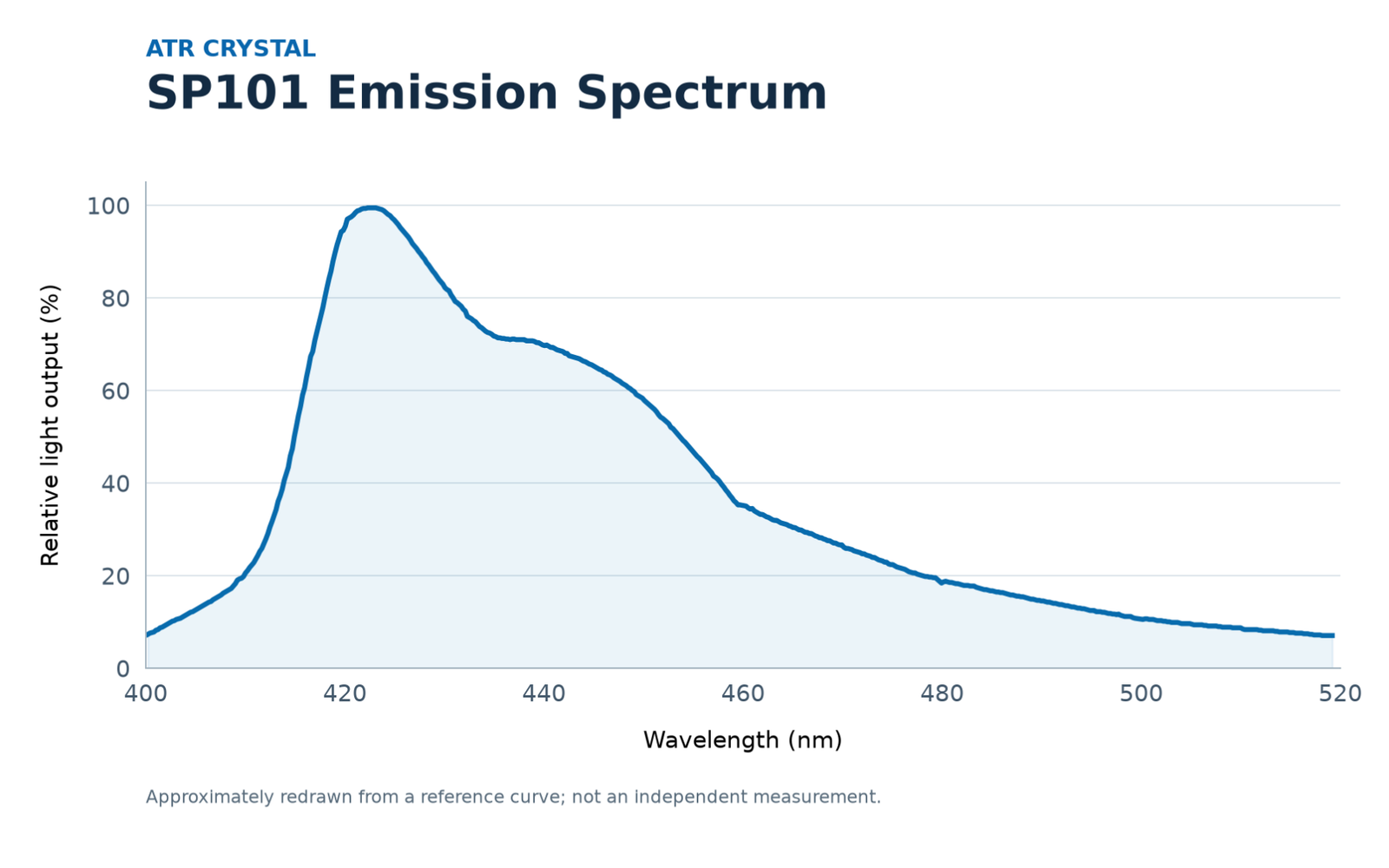
SP101 Plastic Scintillator is a blue-emitting polystyrene-based plastic scintillator for gamma rays, X-rays and general ionizing radiation detection. ATR Crystal supplies custom SP101 plates, slices, blocks, bars, cylinders, rings and large-area detector assemblies with 423 nm emission, 2.4 ns decay time and 210 cm attenuation length.
Built around your specification
- Dimensions
- Active area, thickness, length, width, tolerance, edge margin and mounting features.
Final specifications and acceptance criteria are confirmed for the quoted configuration.
Request a quotationOverview
SP101 Plastic Scintillator for Gamma, X-Ray and Radiation Monitoring
SP101 Plastic Scintillator is a blue-emitting polystyrene-based plastic scintillator used for gamma rays, X-rays and general ionizing radiation detection. It is suitable for large-area radiation monitoring systems, portable instruments, isotope gauges, high-energy physics counters and detector assemblies where low weight, fast response and custom geometry are important.
Compared with many inorganic scintillation crystals, SP101 can be produced in larger shapes and is easier to machine into plates, slices, blocks, bars, cylinders and rings. Its 423 nm emission peak matches many PMTs, SiPMs and silicon photodiodes used in radiation detection systems.
ATR Crystal supplies SP101 as raw scintillator material or as part of a complete detector assembly. Optical coupling to light guides, PMTs, SiPMs or photodiodes, reflector selection, edge polishing, encapsulation, mechanical housing and readout electronics can be reviewed according to your application requirements.
SP101 in Plastic Scintillator Selection
SP101 is a general-purpose blue-emitting plastic scintillator used for gamma-ray, X-ray and charged-particle detection. For comparisons involving SP101, EJ-200-equivalent materials and thin plastic scintillator sheets, read our plastic scintillator selection guide. For large-area atmospheric or cosmic-ray muon projects, see our plastic scintillator panel guide for cosmic-ray muon detection, covering panel thickness, surface treatment, wrapping, photosensor coupling and RFQ requirements.
Advantages of SP101 Plastic Scintillator
- Cost-effective large-area detectionSP101 is suitable for large panels and detector geometries where crystal scintillators may be too costly or difficult to scale.
- Fast responseThe 0.9 ns rise time and 2.4 ns decay time support fast counting and timing-sensitive radiation monitoring.
- Useful light outputThe listed light output is 64% relative to anthracene, with 423 nm blue emission for common detector sensors.
- No hygroscopySP101 is not hygroscopic, which simplifies handling compared with hygroscopic crystals such as NaI(Tl).
- Machinable geometryPlates, slices, blocks, bars, cylinders, rings and drawing-defined parts can be reviewed.
- Detector integration optionsSP101 can be supplied with light guides, PMTs, SiPMs, photodiodes, reflectors, housings and optional electronics.
SP101 Plastic Scintillator Emission Spectrum
Specifications
Custom SP101 Plastic Scintillator Paddles, Plates and Bars
ATR Crystal supplies custom plastic scintillator paddles in SP101 polystyrene, together with plates, bars and drawing-defined shapes. A paddle is a shaped scintillator component with an active detection region and a defined optical readout interface. Send the finished geometry and identify whether the requirement is for a bare polished part, reflector wrapping or a light-guide-coupled component.
For plastic scintillator trigger counters and coincidence counters, include the detector arrangement, PMT or SiPM model, coupling face and timing or threshold requirements. The timing performance of the complete counter also depends on light collection, photosensors and electronics.
| Product Format | Details for Quotation |
|---|---|
| Scintillator paddles | Active body dimensions, thickness, readout-face geometry, photosensor interface and quantity. Include a dimensioned drawing for shaped parts. |
| Plates and slices | Length, width, thickness, active area and required tolerances. |
| Bars and blocks | Length, cross-section, surface finish and single-ended or two-ended readout arrangement. |
| Cylinders and rings | Outside diameter, inside diameter where applicable, height and optical coupling requirements. |
| Other custom shapes | Dimensioned drawing, quantity, mounting features and surface requirements. |
When the scintillator readout face and sensor window differ in size or shape, an SPM100 PMMA light guide can be reviewed as part of the optical interface. For layered cosmic-ray arrangements, see the plastic scintillator panel guide for muon detection.
Final dimensions, tolerances, finishing and assembly scope are confirmed during quotation. Email your drawing, quantity and application to sales@atrscintillator.com.
Properties of SP101 Plastic Scintillators
The following values are published material specifications. Final component dimensions, tolerances and acceptance requirements are confirmed during quotation.
| Property | Listed Value |
|---|---|
| Material | Polystyrene |
| Density | 1.023 g/cm³ |
| Refractive index | 1.58 |
| Light output relative to anthracene | 64% |
| Peak emission wavelength | 423 nm |
| Scintillation decay time | 2.4 ns |
| Rise time | 0.9 ns |
| Light attenuation length | 210 cm |
| Softening temperature | 75°C |
| Operating temperature | −40 to +55°C |
| Listed energy detection range | 50 keV–3 MeV; detector response depends on the complete assembly and measurement conditions. |
SP101 vs. Related Plastic Scintillator Products
SP101 is the general-purpose plastic scintillator option. Related SP products use thinner substrates or ZnS(Ag) coatings for beta, alpha/beta, low-energy gamma or optical coupling functions.
| Product | Main Structure | Primary Use | Selection Notes |
|---|---|---|---|
| SP101 Plastic Scintillator | Blue-emitting polystyrene-based plastic scintillator | Gamma, X-ray and general ionizing radiation detection | Choose for large panels, bars, blocks and general detector assemblies. |
| SP102 Plastic Scintillator | Thin polystyrene-based plastic scintillator | Beta-ray and charged-particle detection | Choose for thin beta detector sheets, typically 0.25-1 mm. |
| SP121 Plastic Scintillator | SP102 base with ZnS(Ag) coating | Alpha and beta radiation measurement | Choose for alpha/beta contamination detector screens. |
| SP122 Plastic Scintillator | SP101 base with ZnS(Ag) coating | Low-energy gamma detection | Choose for coated low-energy gamma monitoring designs. |
| SP123 Plastic Scintillator | PMMA substrate with ZnS(Ag) coating | Alpha-ray detection | Choose for alpha-sensitive ZnS(Ag) screens. |
| SPM100 Light Guide | Cast PMMA optical light guide | Light transfer and sensor coupling | Choose when optical coupling is needed, not as the active scintillator. |
Applications
Applications of SP101 Plastic Scintillators
Portal radioactivity detection systems
Isotope gauges and industrial radiation instruments
Portable radioactive detection instruments
Regional radiation monitoring systems
High-energy physics counters and large-area panels
Custom plastic scintillator detector assemblies
Ordering
SP101 RFQ Checklist
| RFQ Item | Information to Provide |
|---|---|
| Application | Portal monitor, isotope gauge, portable detector, physics counter, area monitor or custom assembly. |
| Geometry | Panel, plate, bar, block, cylinder, ring or drawing-defined shape. |
| Dimensions | Active area, thickness, length, width, tolerance, edge margin and mounting features. |
| Optical requirement | Surface finish, edge polish, wrapping, reflector, light guide and sensor coupling. |
| Readout method | PMT, SiPM, photodiode, electronics, cable and housing requirement. |
| Order information | Prototype quantity, batch quantity, inspection report and delivery schedule. |
Frequently Asked Questions
What is SP101 Plastic Scintillator used for?
Can SP101 be made into large panels?
Is SP101 hygroscopic?
What is the difference between SP101 and SP102?
What information is needed for an SP101 quotation?
Does SP101's relative light-output value state radiation detection efficiency?
No. ATR Crystal lists SP101 light output relative to anthracene; that reference value should not be read as the percentage of incident radiation events detected by a finished instrument. Keep material light-output data separate from an application-level efficiency requirement. For the latter, specify the radiation, geometry, readout and measurement conditions you want assessed.
How should an SP101 paddle drawing identify the optical interface?
Label the face or edge used for light collection, its dimensions and finish, and any interface to a light guide. Provide the sensor geometry or coupling drawing together with the paddle's overall dimensions. Separately identify mounting features and wrapping boundaries so a mechanical feature is not mistaken for a surface intended for optical coupling.
“`
Request a quotation
Send your application and specification requirements directly from this page.
Prefer email? Send your drawing or specification sheet to:
sales@atrscintillator.com