
Short Answer
If a detector needs sharper isotope separation, faster pulse response and better high-count-rate behavior, LaBr3(Ce) scintillation crystal is usually the stronger material to review. If the project needs a mature, cost-effective gamma detector with widely available sizes, simple PMT coupling and practical field use, NaI(Tl) scintillation crystal is still a very reasonable first choice.
The difference is not only “new material versus old material.” LaBr3(Ce) and NaI(Tl) solve different engineering problems. LaBr3(Ce) gives better energy resolution and much faster decay, but it is more expensive, hygroscopic, and has its own intrinsic background from naturally occurring radioisotopes. NaI(Tl) is also hygroscopic and slower, but it remains common because it gives strong light output, acceptable spectroscopy performance and a lower total detector cost for many standard instruments.
Core Technical Difference
The most practical difference is energy resolution. A well-designed LaBr3(Ce) detector can separate gamma peaks more clearly than a typical NaI(Tl) detector. That matters when the spectrum contains several close peaks, when isotope identification must be fast, or when the instrument needs a cleaner decision from a shorter measurement.
NaI(Tl), on the other hand, is the familiar workhorse. Many engineers know how to package it, couple it to PMTs, calibrate it and interpret the spectrum. For routine gamma counting, environmental monitoring, teaching systems and cost-sensitive instruments, that familiarity still has value.
| Parameter | LaBr3(Ce) | NaI(Tl) | Selection Meaning |
|---|---|---|---|
| Typical density | About 5.1 g/cm3 | About 3.67 g/cm3 | LaBr3(Ce) provides stronger stopping power in a smaller volume. |
| Typical light yield | About 63000 photons/MeV | About 38000 photons/MeV | LaBr3(Ce) gives stronger photon statistics, helping spectroscopy. |
| Emission peak | About 380 nm | About 415 nm | Both can be used with PMT readout; window and photocathode choice still matter. |
| Decay time | About 20 ns | About 230-250 ns | LaBr3(Ce) is better for high count rate and fast pulse processing. |
| Energy resolution at 662 keV | Often around 3%-4%, depending on size and assembly | Often around 6%-8%, depending on size and assembly | LaBr3(Ce) separates closer gamma peaks more clearly. |
| Moisture behavior | Hygroscopic | Highly hygroscopic | Both normally need reliable encapsulation. |
| Intrinsic background | Has intrinsic background from natural radioisotopes | Usually lower intrinsic background than LaBr3(Ce) | For very low-background measurements, this must be reviewed carefully. |
| Typical cost position | Higher | Lower | NaI(Tl) is often more practical for routine or large-volume detector builds. |
Why Energy Resolution Changes the Instrument
Energy resolution is not just a nicer-looking spectrum. It changes how confidently the instrument can distinguish one isotope from another. With NaI(Tl), peaks can overlap when the gamma energies are close. This does not make NaI(Tl) useless; many instruments are designed around that limitation. But it means the software, calibration method and measurement time may need more care.
LaBr3(Ce) can make the same task easier because its peaks are narrower. For isotope identification, emergency response instruments, nuclear safeguards, environmental screening or laboratory measurements, this can reduce ambiguity. It is especially useful when the detector must make a decision quickly or work under higher count-rate conditions.
That advantage should be weighed against the full detector design. A poor housing, poor optical coupling or mismatched PMT can waste the benefit of a better crystal. In real procurement, it is better to compare complete detector performance than to compare crystal names only.
Where NaI(Tl) Still Makes Sense
NaI(Tl) remains a common choice for routine gamma spectroscopy and radiation monitoring. Compare the required isotope separation, crystal dimensions, readout and total instrument cost before choosing between NaI(Tl) and LaBr3(Ce).
For crystal dimensions and material properties, review our NaI(Tl) scintillation crystal page. If your design requires a sealed package, see the encapsulated NaI(Tl) scintillators page and specify the optical window, housing dimensions and readout interface.
The project needs better isotope identification, narrower peaks, faster decay, high count-rate behavior or compact spectroscopy performance.
The project needs a standard gamma detector, practical cost, large-size availability, mature PMT coupling or routine radiation monitoring.
Application-Based Selection
| Application | Better Starting Point | Reason |
|---|---|---|
| Handheld isotope identification | LaBr3(Ce) | Better energy resolution and faster response help separate nuclides more clearly. |
| Routine gamma counting | NaI(Tl) | NaI(Tl) gives mature performance at a lower detector cost. |
| High count-rate spectroscopy | LaBr3(Ce) | The 20 ns decay time is useful for pulse processing and count-rate capability. |
| Large-area radiation monitoring | NaI(Tl) | Large sizes and standard detector assemblies are easier to source economically. |
| Very low-background measurement | Review carefully | LaBr3(Ce) intrinsic background may be a limitation; NaI(Tl), HPGe or other materials may need comparison. |
| Oil logging or elevated-temperature detector | Depends on package | Both material and encapsulation design must be reviewed against temperature, vibration and shock conditions. |
Packaging Is Not a Small Detail
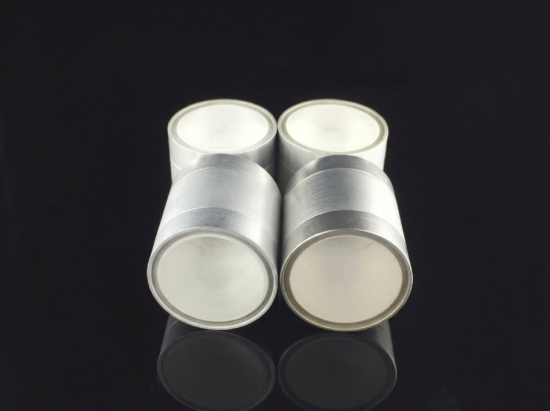
Both materials dislike moisture. That single fact shapes the whole product. A bare crystal is not the same as a finished detector. For LaBr3(Ce), the package must protect the material while preserving optical output and energy resolution. For NaI(Tl), hermetic sealing is also essential; poor sealing can slowly damage the crystal and shift performance over time.
When comparing quotations, check what is included: crystal size, housing material, optical window, reflector, coupling window, PMT or SiPM option, connector, test report and energy-resolution guarantee. A cheaper quotation may not be cheaper if it leaves out the sealing, window, electronics or inspection report required for the real instrument.
LaBr3(Ce) or NaI(Tl): What to Send in an RFQ
A good RFQ should make the detector requirement clear enough for the supplier to judge both material and package. The following details reduce the chance of getting an attractive but technically incomplete price.
- Target application: isotope identification, laboratory spectroscopy, survey meter, well logging, monitoring system or custom detector module.
- Required crystal dimensions, tolerances and quantity, with a drawing for custom geometry.
- Energy range and main isotopes or gamma energies of interest.
- Target energy resolution, especially at 662 keV if Cs-137 testing is required.
- Readout method: PMT, SiPM or photodiode, including the sensor model and optical coupling requirements.
- Operating temperature, storage temperature, vibration, shock and humidity conditions.
- Whether the requirement is a standalone crystal or an encapsulated scintillator; include optical-window and mechanical-interface requirements.
Start with the material specifications on our LaBr3(Ce) scintillation crystal and NaI(Tl) scintillation crystal pages. If the project needs a non-hygroscopic material with high light output, GAGG(Ce) scintillation crystal may also be worth comparing.
Send the details above through the LaBr3(Ce) crystal quotation form or the NaI(Tl) crystal quotation form. State any sealing, coupling or assembly work required so that the quotation can define the supply scope and acceptance criteria.
Frequently Asked Questions
Is LaBr3(Ce) always better than NaI(Tl)?
No. LaBr3(Ce) is usually better for energy resolution, timing and high count-rate spectroscopy, but NaI(Tl) is often better for cost-sensitive instruments, large detector sizes and routine gamma counting.
Why is LaBr3(Ce) better for isotope identification?
LaBr3(Ce) usually provides narrower gamma peaks than NaI(Tl). Better peak separation helps the instrument identify nuclides more confidently, especially when the spectrum contains nearby or overlapping gamma lines.
Does LaBr3(Ce) have intrinsic background?
Yes. LaBr3(Ce) has intrinsic background related to natural radioisotopes such as La-138, and sometimes trace actinium contamination depending on material quality. For very low-background measurements, this must be considered.
Do both LaBr3(Ce) and NaI(Tl) need encapsulation?
Yes. Both are hygroscopic, so practical scintillator products normally use sealed housings, optical windows and suitable reflector structures. The package quality is part of the detector performance.
Which material should I choose for a 2 x 2 inch gamma detector?
If the detector is for routine gamma counting or general spectroscopy, NaI(Tl) is often the first option to review. If the instrument needs sharper isotope identification or faster count-rate handling, LaBr3(Ce) may justify the higher cost.
Can LaBr3(Ce) replace HPGe?
No, not directly. LaBr3(Ce) has much better energy resolution than NaI(Tl), but HPGe still offers much higher resolution for laboratory-grade spectroscopy. LaBr3(Ce) is attractive when room-temperature operation, speed and field usability matter.