
Scintillator energy resolution describes the width of a measured photopeak relative to its energy. It is commonly reported as FWHM divided by photopeak energy, expressed as a percentage. A smaller percentage means a narrower peak at that energy. For a useful comparison, the source energy, crystal geometry, optical readout and measurement conditions must be stated alongside the number.
A quotation that says “7% resolution” leaves a purchasing question unanswered: 7% with which crystal, sensor and test setup? This guide explains how to turn a resolution target into a component requirement that can be reviewed and compared.
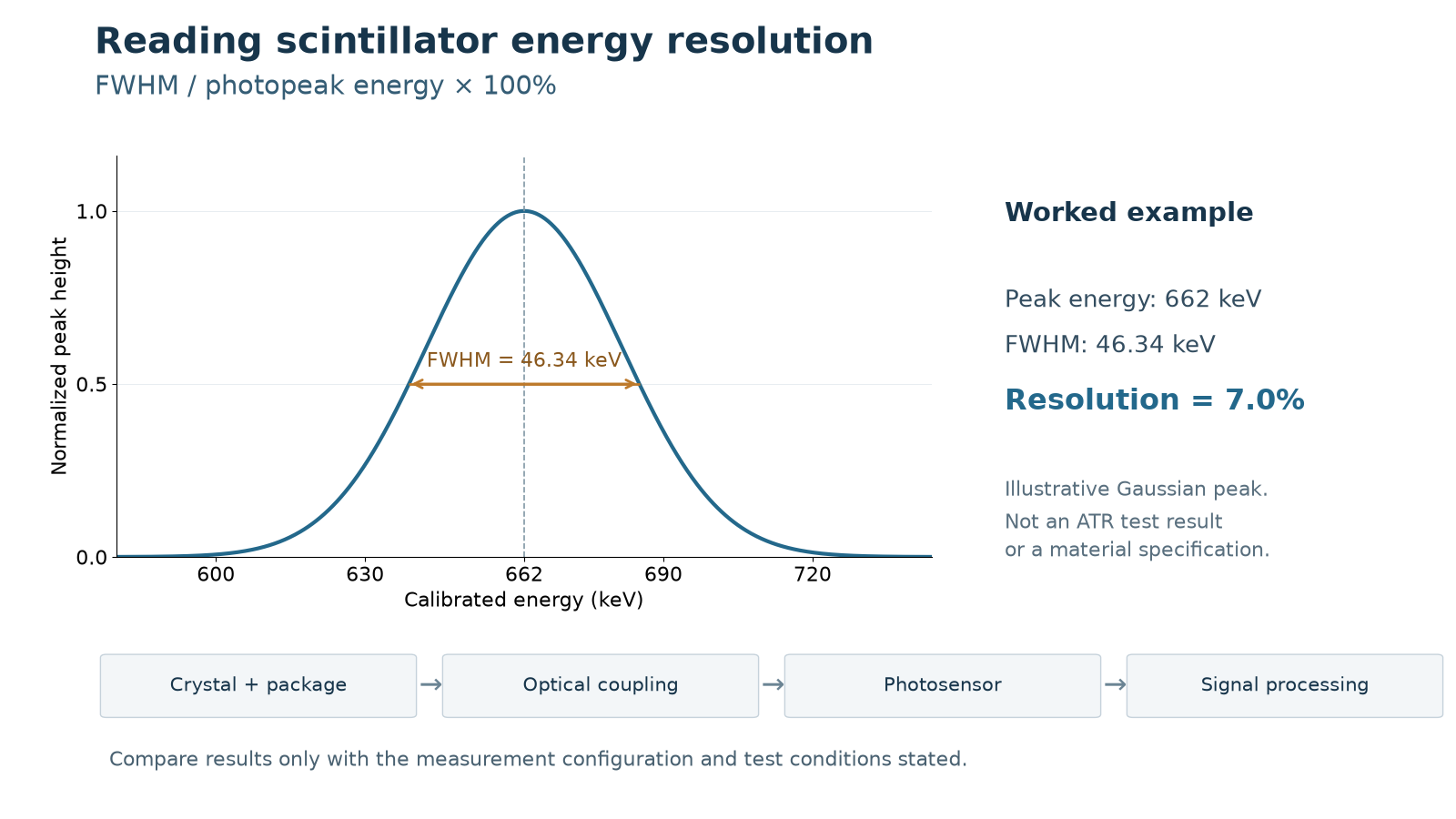
How to calculate energy resolution from FWHM
Energy resolution (%) = FWHM (keV) ÷ photopeak energy (keV) × 100.
FWHM means full width at half maximum. For a calibrated peak centred at 662 keV with a width of 46.34 keV at half its maximum, the calculation is 46.34 ÷ 662 × 100 = 7.0%. These are illustrative numbers, not a specification for a particular crystal.
Use a calibrated energy scale and identify the peak-fitting and background treatment. A peak width in raw channels needs a defined calibration before it can be compared with a width in keV. Hamamatsu’s Photomultiplier Tubes technical guide illustrates this peak-width definition.
What “at 662 keV” adds to the specification
The energy is part of the result. The approximately 662 keV gamma line from Cs-137 is a common reference, but a percentage measured there does not define resolution at every other energy. Do not compare one component’s result at 662 keV with another component’s result at a lower energy as if the test were identical.
For a project with a different energy interval of interest, request an acceptance requirement appropriate to that interval. Keep the reference-energy result and the application requirement as separate entries in the specification when both matter. Luxium’s Scintillation Detector Operating Manual, under Performance Resolution, explains why resolution values must be associated with the measured energy.
Why the same scintillator can have different reported values
The measured peak reflects the crystal and its readout. Hamamatsu’s Photomultiplier Tubes handbook, section 7.2, discusses separate scintillator and photomultiplier contributions to energy resolution. It also describes the role of optical coupling and light collection. A material name therefore does not define the complete measurement.
Compare crystal dimensions, reflector and window arrangement, coupling, photosensor and signal processing. If a supplier changes one of these between tests, ask which configuration the quoted value describes. A result from a small reference sample should not automatically become the acceptance limit for a different finished component.
Packaging choices can also be relevant to comparisons. Luxium’s technical FAQs distinguish spectroscopy-focused and compact assembly designs, with different photosensor arrangements. Those are examples of configuration-specific results, not performance specifications for ATR products.
A checklist for comparing two quotations
| Record this item | What to ask the supplier |
|---|---|
| Meaning of the value | Is it a material reference, a result from a specific sample, or an agreed acceptance limit? |
| Radiation energy | Which source line and calibrated peak were used? |
| Crystal and package | What are the active dimensions, material grade, window and reflector arrangement? |
| Readout | Which photosensor, coupling arrangement and signal-processing settings apply? |
| Test conditions | What temperature, source geometry, count-rate conditions and acquisition settings apply? |
| Analysis | How are calibration, background and peak fitting handled? |
| Delivery evidence | Which components are tested, and what report or result is included if agreed? |
Put the answers in one comparison sheet. Where a field is missing, mark it as unconfirmed rather than filling it with an assumption. This makes a difference between quotations visible before an order is placed.
Write the target without implying an existing test result
A useful RFQ separates the requested component from the measurement requirement. For example:
Material and active dimensions: as shown on drawing [revision]. Supply scope: crystal component and specified packaging. Requested energy-resolution limit: [target]% FWHM at [energy] keV. Photosensor and coupling: [configuration]. Acquisition and analysis method: [method]. Please confirm whether this requirement can be accepted, identify any proposed changes to the test setup, and state which test documentation is included in the quotation.
The brackets are fields to complete, not an ATR performance promise. If you already have an instrument, include its readout specification and say which parts of the configuration must remain fixed.
Specify energy resolution when ordering scintillator crystals
Keep the material choice and the acceptance test together. Review NaI(Tl), LaBr3(Ce), GAGG(Ce) and LYSO(Ce) for material properties and component options. For a focused comparison, see LaBr3(Ce) vs NaI(Tl) or GAGG vs LYSO.
Send ATR Crystal your drawing, quantity, energy interval, readout configuration and requested acceptance criteria through the technical sales contact page. Component specifications and any agreed testing are confirmed in the quotation.
Frequently asked questions
Does 7% energy resolution mean 7% detection efficiency?
No. The resolution percentage describes a peak’s relative width. It is not the fraction of incident radiation counted by the instrument. Specify an efficiency requirement separately, including its definition and measurement geometry.
Can I compare a PMT result with a SiPM result?
You can compare the stated configurations, but changing the readout means the difference cannot be attributed to the crystal material alone. Record the photosensor and measurement setup with each result.
Is a typical value the same as a guaranteed acceptance limit?
No. A reference value helps with initial selection. A delivery acceptance limit needs explicit agreement about the supplied configuration, test method and required result.