
A scintillation detector measures light produced by radiation, while a Geiger counter records electrical discharges in a gas-filled tube. The practical difference is the information you can obtain: a suitable scintillation system can measure deposited energy, whereas a conventional Geiger–Müller (GM) counter counts events without resolving their energies.
Strictly speaking, a scintillator is a material, not a complete instrument. This article compares a scintillation detector system with a GM counter. For an introduction to the light-generation process, see what a scintillator is and how it works.
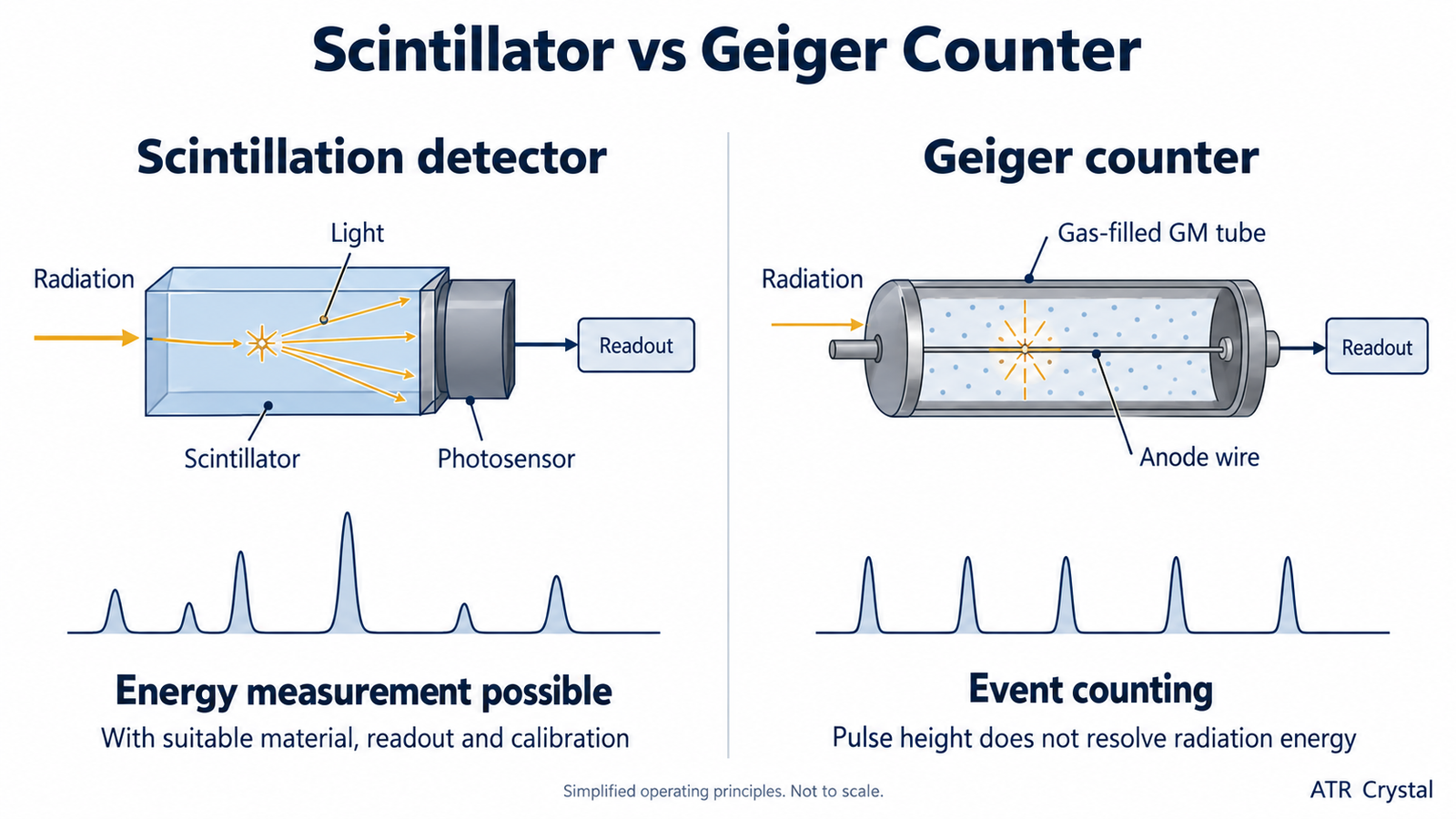
Pulse traces are illustrative, not measured data.
Click the image to view it at full size.
Scintillation Detector vs Geiger Counter: Main Differences
| Feature | Scintillation detector | Geiger counter |
|---|---|---|
| Detection medium | Light-emitting material coupled to a photosensor | Gas-filled GM tube |
| Signal | Light converted into electrical pulses | Electrical discharge pulses |
| Energy measurement | Possible with suitable material, electronics and calibration | Pulse height does not resolve incident radiation energy |
| Selection question | Which material and readout meet the measurement requirement? | Which tube and instrument suit the radiation and measurement range? |
| Universal winner? | No. Compare complete instruments under the same conditions. | |
The operating-principle distinction is described in OpenStax’s introduction to radiation detectors.
Can They Identify a Radioactive Isotope?
A conventional GM counter cannot identify an isotope from pulse heights. Detecting more counts tells you that its response has increased; it does not reveal which isotope caused that increase.
A scintillation spectrometer records a distribution of pulse heights. With energy calibration, this becomes an energy spectrum. Suitable gamma-ray spectra can contain peaks that help identify radionuclides. However, a scintillation instrument that only displays a total count rate is not automatically a spectrometer.
NaI(Tl) is an established material for gamma spectroscopy. Resolution, detector size, background and measurement time affect how clearly spectral features can be separated. AMETEK ORTEC’s NaI(Tl) spectroscopy experiment explains the connection between deposited energy and the measured pulse.
Is a Scintillator More Sensitive?
There is no useful single sensitivity ratio for all scintillators and GM tubes. Before comparing figures, check whether the specifications use the same radiation source, energy, distance, geometry and units. Also compare background and the time needed to distinguish a signal from that background.
For a purchasing comparison, request the response at the energy relevant to your application. A number measured with one source should not be treated as a prediction for every other source. Detector volume, entrance window and instrument settings also belong in the comparison.
Why Counts per Minute Are Not a Direct Dose Comparison
Two instruments can display different count rates in the same radiation field. A higher counts-per-minute (CPM) reading alone does not establish a higher dose rate or a better instrument.
Dose-rate measurement requires the appropriate instrument response and calibration. For example, Ludlum documents a low-energy over-response for its pancake GM detector and an optional compensation filter in the Model 26-3 manual. This is a specific detector example, not a correction factor that can be transferred to other instruments.
Choosing a Scintillation Material for Your Design
If your project requires a scintillator, define the measurement before choosing a crystal. Specify the radiation and energy range, available space, photosensor, operating temperature, and whether the priority is counting, timing or energy resolution.
Use our scintillation crystal selection guide to compare material options. If the design calls for a plastic component, start with the plastic scintillator selection guide.
For a material quotation from ATR, send the required material, dimensions, quantity and any drawing to sales@atrscintillator.com. Include your photosensor and intended measurement so that the component requirements can be discussed in context.