
GAGG vs CsI(Tl): Which Should You Evaluate First?
When comparing GAGG(Ce) and CsI(Tl) scintillators, start with the required count rate, photosensor and packaging. Evaluate GAGG(Ce) when faster scintillation response and non-hygroscopic handling are priorities. Evaluate CsI(Tl) when its strong green emission and established silicon-photodiode readout suit the instrument, and its slower response can be accommodated.
Neither material is the best choice for every gamma detector. ATR Crystal supplies GAGG(Ce) scintillation crystals and CsI(Tl) scintillation crystals for review against your dimensions, optical interfaces and application requirements.
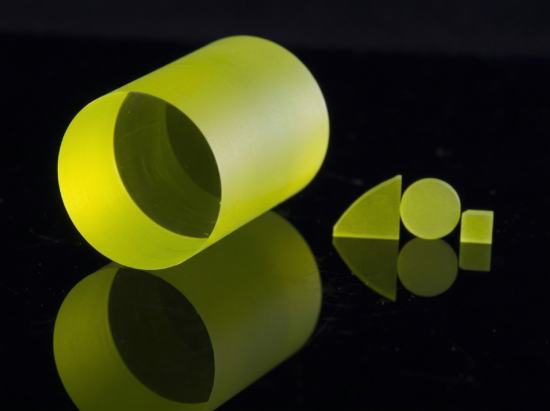
GAGG(Ce) vs CsI(Tl): Typical Properties
These rounded reference values describe commonly reported materials, rather than acceptance limits for every supplied crystal. GAGG grades and scintillation-decay components vary; request the data for the proposed grade.
| Property | GAGG(Ce) | CsI(Tl) |
|---|---|---|
| Density | About 6.6 g/cm³ | About 4.5 g/cm³ |
| Emission peak | Commonly around 520–530 nm | Commonly around 540–550 nm |
| Scintillation response | Main decay component often around 60–100 ns in commonly studied grades; other grades differ. | Commonly reported primary components around 0.7–1 µs, with additional components. |
| Moisture sensitivity | Non-hygroscopic | Slightly hygroscopic; protect from water and high humidity. |
| Readout to evaluate | SiPM, APD, photodiode or suitable PMT | Photodiode, APD, SiPM or green-sensitive PMT |
GAGG vs CsI for SiPM and Photodiode Readout
Both scintillators emit in the green region. For a SiPM, compare its photon detection efficiency across the crystal emission spectrum at the intended operating voltage. Do not assume that a sensor optimized for blue scintillators will provide the same detected signal with GAGG or CsI(Tl).
For a photodiode or APD, review spectral response, active area and the noise of the complete readout chain. Include the sensor model, coupling face and any light guide in the crystal drawing. With a PMT, check green-wavelength sensitivity rather than selecting only by tube diameter.
Which Material Is Better at Higher Count Rates?
GAGG(Ce) is a useful candidate when a faster light pulse is needed. Closely spaced events can overlap in a slower scintillator and readout chain, making pulse separation more difficult. The usable count rate nevertheless depends on electronics, pulse processing and acceptable pile-up, not only the crystal decay time.
A published comparison found similar gamma-ray energy resolution for its GAGG(Ce) and CsI(Tl) detectors with a 2 µs shaping time constant. At shorter shaping time constants, GAGG performed better in that setup. This illustrates why a short signal-processing window can favour a faster scintillator; it is not a guaranteed count-rate or resolution specification for ATR parts.
Does GAGG Always Have Better Energy Resolution?
No. Compare measured resolution at the same gamma-ray energy and review the crystal dimensions, sensor, optical treatment and processing settings. A percentage measured at 662 keV is not directly interchangeable with one measured at a different energy.
If spectroscopy is the main requirement, provide the desired FWHM energy resolution, operating temperature and count-rate range. Establish the test conditions before treating a datasheet value as a detector acceptance limit.
Moisture Protection and Detector Packaging
GAGG’s non-hygroscopic nature simplifies moisture-related handling. It still needs protection against surface damage, mechanical stress and unwanted light entering the detector housing.
CsI(Tl) is slightly hygroscopic. Discuss the expected humidity, protective housing and optical window when specifying it. A change from CsI(Tl) to GAGG should include a review of the mechanical and optical interfaces, rather than assuming a direct replacement.
Choosing Monolithic Crystals or Pixelated Arrays
A single crystal may suit material evaluation or a detector without pixel-by-pixel position readout. For an imaging layout, compare the GAGG(Ce) array and CsI(Tl) array options. Specify pixel size, pitch, pixel count, reflector thickness and readout-face geometry.
For X-ray imaging, include the integration time and afterglow requirement. A short scintillation decay time alone does not establish low afterglow or image quality.
What to Send for a GAGG or CsI(Tl) Quotation
- Radiation type, energy range and intended application.
- Crystal dimensions, tolerances and prototype or production quantity.
- Photosensor model, coupling face and surface-finish requirements.
- Expected count rate and signal-processing or integration time.
- Energy-resolution or afterglow targets, with the proposed test method.
- Housing, window, reflector and operating-environment requirements.
Send your drawing for a material review and quotation, or email sales@atrscintillator.com. If both materials are candidates, request quotations for the same geometry and supply scope so that the comparison is meaningful.
For other material options, read our scintillation crystal selection guide.