
Plastic Scintillator Slabs for Desktop Muon Detectors
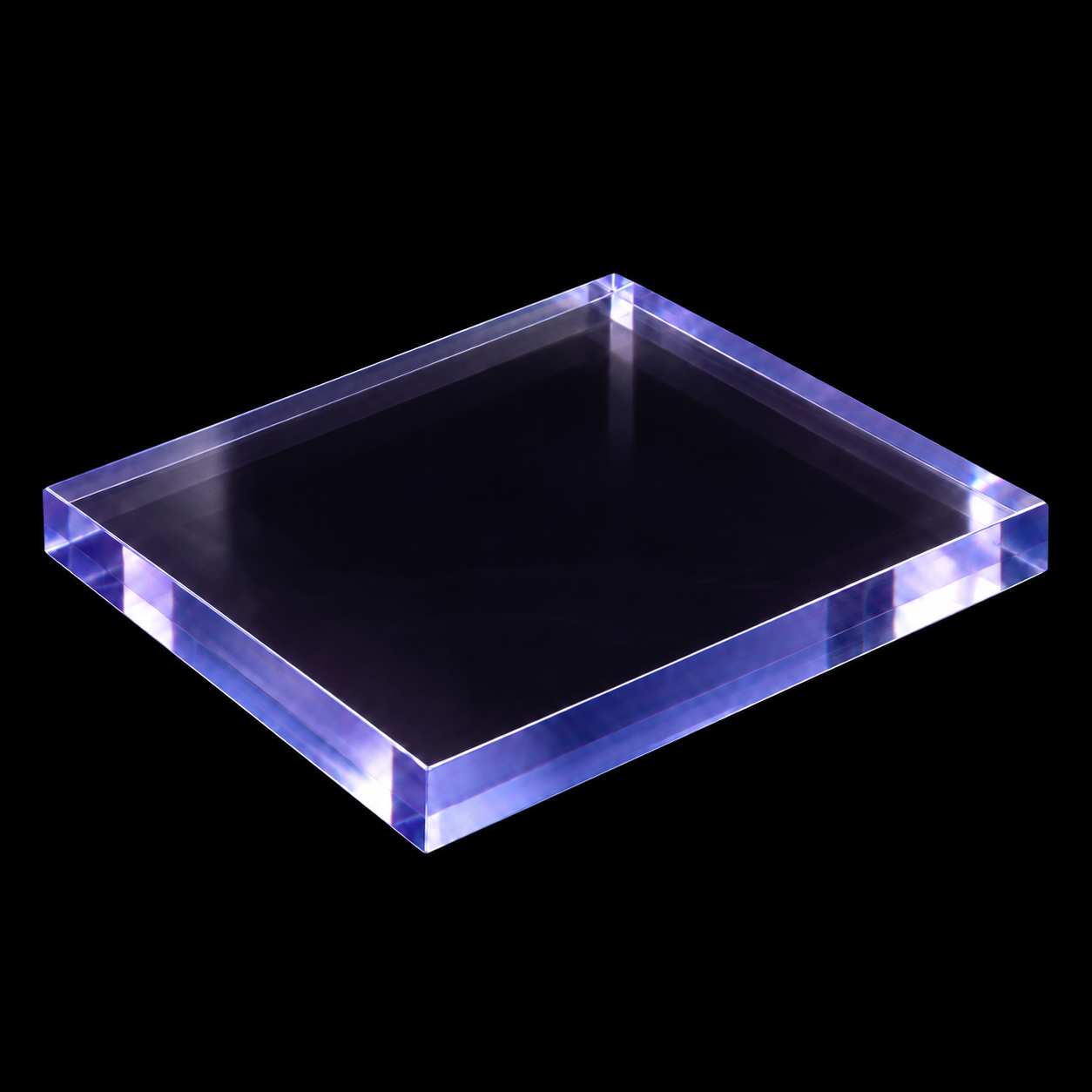
Desktop muon detectors such as the open-source CosmicWatch design developed at MIT use a single 5 × 5 × 1 cm plastic scintillator slab read by a silicon photomultiplier (SiPM). The design is used in teaching labs, including courses at MIT, the University of Delaware and Cornell University, and by student and outreach projects.
ATR Crystal supplies HZ-200 fast plastic scintillator cut to this size, or to any other size your detector needs. This page lists the material data and what to include in an order for a class set or a single build.
HZ-200 Material Data
| Property | Reported value |
|---|---|
| Light output relative to anthracene | ≥66% |
| Emission peak region | 395–425 nm |
| Rise time | 0.9 ns |
| Decay time | 2.4 ns |
| Optical attenuation length | >2 m |
| Refractive index | 1.58 |
| Softening temperature | 75–80 °C |
A 1 cm slab is short compared with the attenuation length, so light loss inside the scintillator is small at this size. Light collection depends mainly on surface finish, wrapping and the optical coupling to the SiPM. For a side-by-side comparison with EJ-200 reference values, see HZ-200 vs EJ-200.
A Note on Material Choice
The CosmicWatch v3X paper describes a polystyrene-based scintillator doped with PPO and POPOP. HZ-200 is offered as an alternative for projects that would otherwise use EJ-200. Both are fast, blue-emitting plastic scintillators of the kind normally used for muon counting. If your course compares results with published CosmicWatch data, test the first detectors in your own setup before ordering a full class set.
What to Specify in Your Order
- Size and tolerance: 50 × 50 × 10 mm, or your own dimensions, with the tolerance you need
- Surface finish: which faces are polished. The face coupled to the SiPM should be polished; state whether the other faces should be polished too
- Wrapping: bare slabs, or slabs wrapped in reflector and light-tight material
- Quantity: a single unit, a class set, or a recurring order each term
- Delivery country and any paperwork your institution needs for purchasing
Assembly Notes
- Use optical grease or an optical pad between the slab and the SiPM, and keep the coupling face clean.
- Wrap the slab in a diffuse reflector, then make it light-tight. A small light leak raises the SiPM noise rate and the count of false events.
- Check the SiPM’s spectral response against the 395–425 nm emission region.
- Handle the slab by its edges. Fingerprints and scratches on polished faces reduce light collection.
Orders for Teaching Labs
A lab course usually builds several detectors, and a course that runs every term can reorder the same size. Send the number of detectors per term and we will quote a class set. Paid samples are available if you want to evaluate a few slabs before ordering a set.
For larger counters, such as panels for muon telescopes or veto systems, read Plastic Scintillator Panels for Cosmic-Ray Muon Detection.
Request a Quotation
Send the size, finish, wrapping and quantity to sales@atrscintillator.com, or use the online inquiry form.
CosmicWatch is an independent open-source project. ATR Crystal is not affiliated with or endorsed by the CosmicWatch team.